
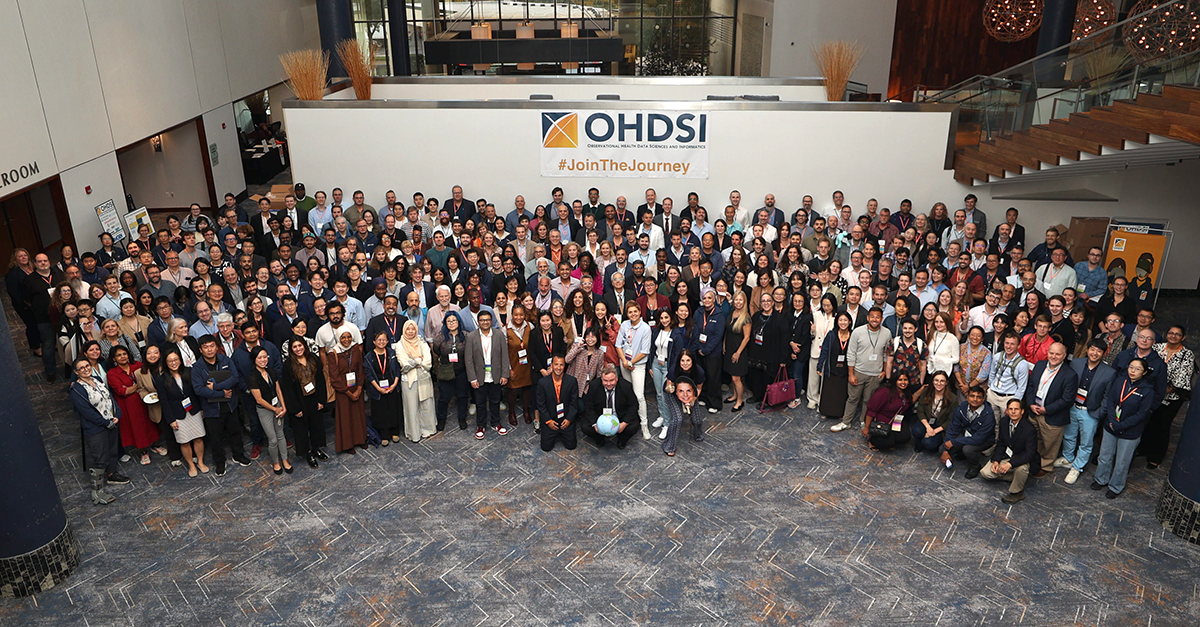
 Observational Health Data Sciences and Informatics (OHDSI, pronounced “Odyssey”) strives to promote better health decisions and care by generating reliable evidence from standardized health data worldwide. It focuses on large-scale analytics that adhere to empirically proven methodological best practices and promotes collaboration through open science.
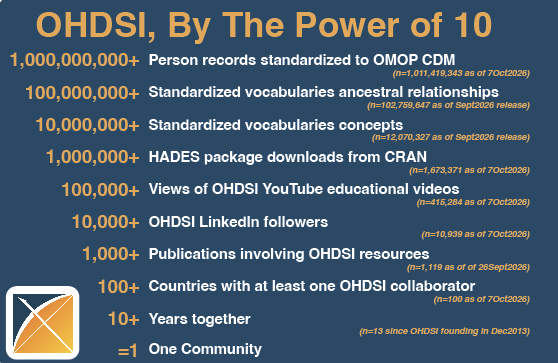
Founded in 2013, OHDSI is a growing collaborative of more than 5,300 researchers from various fields (including biomedical informatics, epidemiology, statistics, computer science, health policy, clinical sciences), representing different stakeholders (including academia, industry, government and regulatory authorities, and health providers) across 100 nations and six continents. OHDSI has created a global distributed data network that applies one open community data standard, the OMOP Common Data Model, and collectively represents more than one billion patient records around the world. It has also developed open-source standardized analytic tools to help turn these standardized data into reliable evidence.
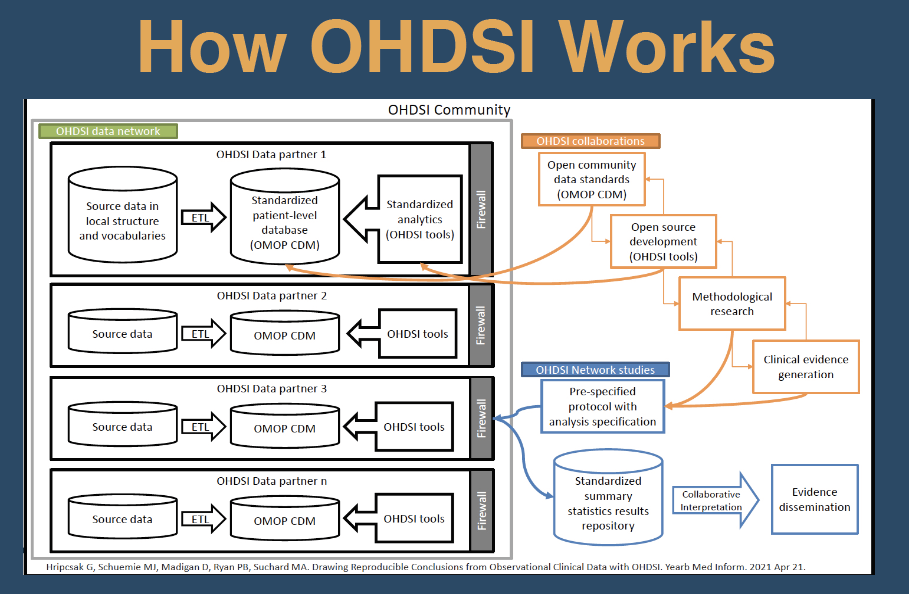 OHDSI collaborates to establish and evolve shared community data standards, conduct methodological research to identify and evaluate scientific best practices, develop open-source software to codify those best practices into transparent and reproducible tools, and apply these tools and practices to generate clinical evidence.
Researchers across our community conduct network studies by identifying a research question and defining protocols and analysis specifications to answer their question. Data partners across the OHDSI distributed network can opt in to execute the study analysis package, sharing aggregated summary statistics (not individual patient data), which are then collaboratively interpreted before public dissemination. The OHDSI Evidence Network connects researchers and organizations with health data who are interested in collaborating and contributing to network studies that generate reliable real-world evidence.
 Our global community always welcomes new collaborators. OHDSI has more than 40 workgroups, as well as regional chapters and national nodes, that present opportunities for members to apply their skills and interests.
OHDSI’s research has been presented across various scientific societies, such as American Medical Informatics Association (AMIA), American Statistics Association (ASA/JSM), and International Society of Pharmacoepidemiology (ISPE), and published in top medical journals, including The Lancet, JACC, JAMA, BMJ, PNAS and JAMIA. It has also informed regulatory agencies, such as the U.S. Food & Drug Administration (FDA) and the European Medicines Agency (EMA).
Please learn more about OHDSI through our website and Join The Journey!