
Data Standards

Make different health data speak a common research language

Health data come from many settings, including clinical care, insurance claims, registries, research, and public health. Each source organizes and codes information differently, so the same clinical idea may appear in many forms. The OMOP Common Data Model provides a shared structure for the data, and the OHDSI Standardized Vocabularies provide a shared way to represent clinical meaning.

What Standardization Does

Standardization does not make every database identical or eliminate differences in data provenance, capture, or quality. It transforms source data into a consistent research representation while retaining information about the original source. Researchers can then define an analysis once and apply the same specification across participating OMOP databases, while assessing whether each database is fit for the intended use.
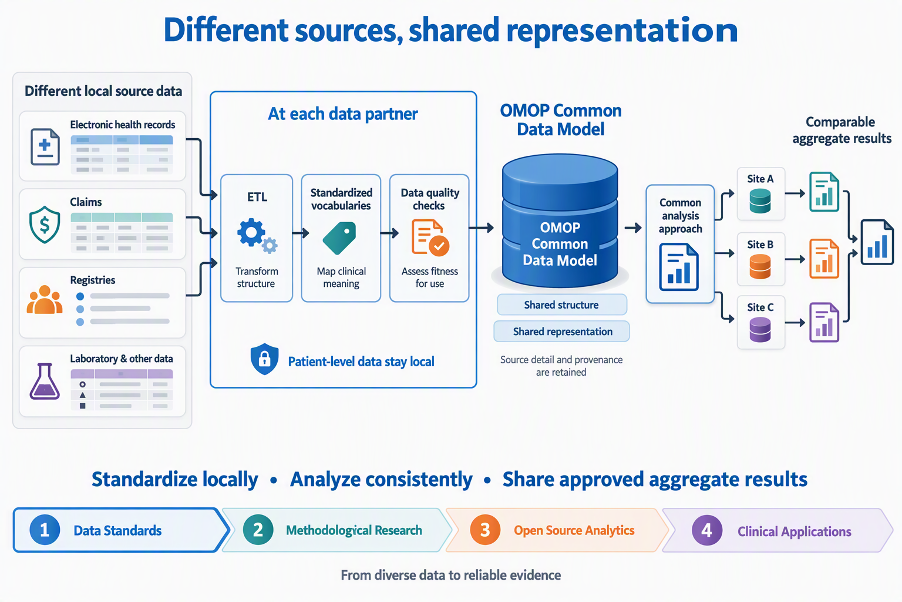
Different sources, shared representation. Left: EHR, claims, registry, and laboratory data. Center: ETL + vocabulary mapping + quality checks. Right: OMOP CDM feeding one common analysis package. Add a note: “Transformation is local; research definitions and aggregate results can be shared.”
  • Common structure: agreed tables and fields for people, visits, conditions, drugs, measurements, procedures, and other clinical events.
  • Common meaning: local codes are mapped to standardized concepts and relationships.
  • Transparent transformation: an extract-transform-load—or ETL—process documents how source data become OMOP data.
  • Quality assessment: standardized checks evaluate conformance, completeness, and plausibility before data are used for research. The Data Quality Dashboard implements thousands of configurable checks against OMOP databases.

One standard, many kinds of data

OMOP can represent data originating from EHRs, claims, registries, and other healthcare sources. The EHDEN descriptive study illustrates this diversity: its 210 harmonized sources across 30 countries included primary care, secondary care, mixed-care, disease-specific, population-based, EHR, and laboratory data.

Why this matters

When participating organizations use the same data and vocabulary standards, researchers can define an analysis once and run it consistently at each participating site. Patient-level data remain under each data partner’s control. Approved aggregate results can then be brought together, while study definitions, code, and diagnostics remain transparent and comparable across settings.

Learn more

Useful Publications

  1. Reich C, Ostropolets A, Ryan P, et al. OHDSI Standardized Vocabularies—a large-scale centralized reference ontology for international data harmonization. JAMIA. 2024;31:583–590. https://doi.org/10.1093/jamia/ocad247 4
  2. Blacketer C, Schuemie MJ, Moinat M, et al. Advancing Real-World Evidence Through a Federated Health Data Network (EHDEN): Descriptive Study. JMIR. 2025;27:e74119. https://doi.org/10.2196/74119 12
  3. Blacketer C, Defalco FJ, Ryan PB, Rijnbeek PR. Increasing trust in real-world evidence through evaluation of observational data quality. JAMIA. 2021;28:2251–2257. https://doi.org/10.1093/jamia/ocab132 10
  4. Voss EA, Makadia R, Matcho A, et al. Feasibility and utility of applications of the common data model to multiple, disparate observational health databases. JAMIA. 2015;22:553–564. https://doi.org/10.1093/jamia/ocu023 14
  5. Overhage JM, Ryan PB, Reich CG, et al. Validation of a common data model for active safety surveillance research. JAMIA. 2012;19:54–60. https://doi.org/10.1136/amiajnl-2011-000376 8