
Clinical Applications

Apply standards, methods, and software to questions that matter

OHDSI collaborators use standardized data, evaluated methods, and open-source software to study disease patterns, treatment use, comparative effectiveness, safety, and patient risk. Participating data partners run shared study packages under local governance and contribute approved aggregate results for collaborative interpretation.

Together, the OHDSI community tries to answer the questions that fulfill our mission of generating the evidence that promotes better health decisions and better care.
Illustrative Applications

  • Choosing first-line hypertension treatment: LEGEND-HTN compared major antihypertensive drug classes across a multinational network, demonstrating comprehensive comparative research with shared methods and diagnostics.
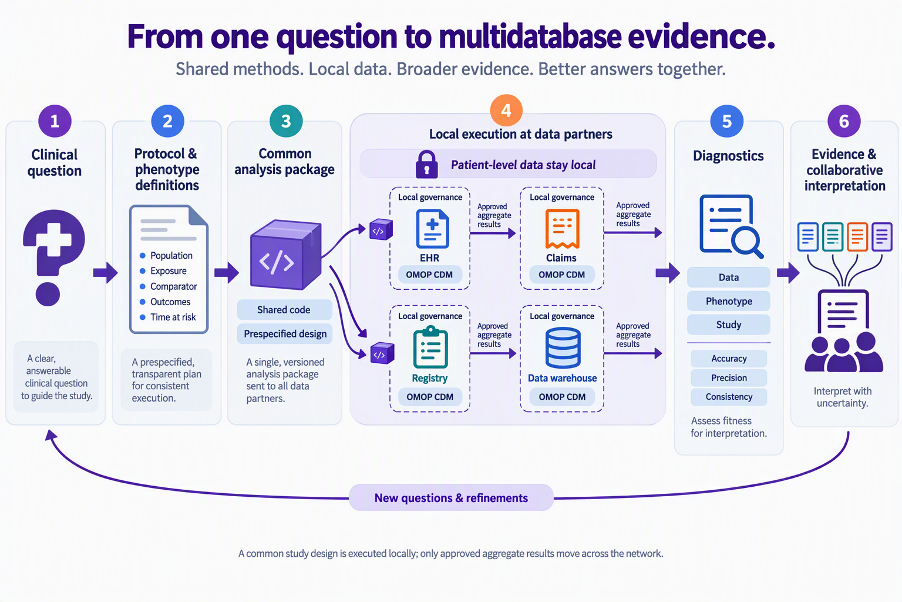
A shared protocol and analysis package is executed locally across equally weighted data partners; patient-level data remain local, while approved aggregate results pass through diagnostics before collaborative interpretation.
  • Cardiovascular outcomes in type 2 diabetes: LEGEND-T2DM compared four second-line treatment classes across ten federated data sources and nearly 1.5 million eligible patients. The study illustrates how a shared protocol, common diagnostics, and replication across heterogeneous settings can complement evidence where head-to-head trials are limited; its scale alone does not determine the reliability of its conclusions.
  • Preparing for vaccine safety monitoring: the BMJ background-incidence study characterized prespecified adverse events across multiple countries, demonstrating why context-specific baseline rates matter before interpreting post-vaccination signals.
  • Rapid medication-safety evidence during COVID-19: the hydroxychloroquine analysis evaluated HCQ alone and with azithromycin among rheumatoid-arthritis patients, demonstrating how an existing network can address urgent safety questions without presenting the study as a randomized treatment trial.
  • Investigating a rare eye outcome: The semaglutide–NAION study used 14 OHDSI databases, alternative outcome definitions, two study designs, phenotype evaluation, negative controls, and prespecified diagnostics. The analysis found a modest association that warranted further investigation but did not establish causality

Useful Publications

  1. Suchard MA, Schuemie MJ, Krumholz HM, et al. Comprehensive comparative effectiveness and safety of first-line antihypertensive drug classes. The Lancet. 2019;394:1816–1826. https://doi.org/10.1016/S0140-6736(19)32317-715
  2. Khera R, Aminorroaya A, Dhingra LS, et al. Comparative Effectiveness of Second-Line Antihyperglycemic Agents for Cardiovascular Outcomes. JACC. 2024;84:904–917. https://doi.org/10.1016/j.jacc.2024.05.069 16
  3. Li X, Ostropolets A, Makadia R, et al. Characterising the background incidence rates of adverse events of special interest for covid-19 vaccines in eight countries. BMJ. 2021;373:n1435. https://doi.org/10.1136/bmj.n1435 17
  4. Lane JCE, Weaver J, Kostka K, et al. Risk of hydroxychloroquine alone and in combination with azithromycin in rheumatoid arthritis. Lancet Rheumatology. 2020;2:e698–e711. https://doi.org/10.1016/S2665-9913(20)30276-918
  5. Cai CX, Hribar M, Baxter S, et al. Semaglutide and Nonarteritic Anterior Ischemic Optic Neuropathy. JAMA Ophthalmology. 2025;143:304–314. https://doi.org/10.1001/jamaophthalmol.2024.6555 8