Can you discuss your background and career journey?
My career has always revolved around one central question: how can we make health data more useful for clinicians, researchers, and ultimately patients?
I trained as a medical informatician and completed a PhD in Medical Informatics at Erasmus MC. After finishing my PhD, I did something that might seem unusual for an academic: I left academia. I wanted to get out into the real world and solve real problems.
For more than a decade, I worked on electronic health record implementations in hospitals across the Netherlands. That experience taught me two important lessons: technology alone does not improve healthcare, and turning data into useful knowledge is much harder than it looks.
Those lessons eventually led me to standardization and collaboration. Today, back at Erasmus MC, I focus on health data standardization and (inter)national collaboration. Through OHDSI, I’ve been able to bring together many of the things I’ve learned throughout my career: technology, healthcare, research, and most importantly, people.
Working out of Erasmus MC, you are at the heart of OHDSI activity in Europe. How has being embedded in such a collaborative environment shaped your approach to open science and health data standardized models?
One of the greatest advantages of working at Erasmus MC is being surrounded by people who genuinely believe that science advances faster when we work together.
That environment has reinforced something I care deeply about: standards aren’t just technical solutions, they are enablers of collaboration.
The OMOP Common Data Model is often described as a data model, but I see it as a collaboration model. It creates a shared language that allows researchers, clinicians, and institutions to learn from each other across borders.
For me, open science is about lowering barriers so that more people can participate, contribute, and build on each other’s work.
 You have played a key role in driving national node development across Europe. What do you see as the primary value of establishing national nodes, and how do they help translate global OHDSI goals into local impact?
National nodes are where the global OHDSI vision meets local reality.
Every country has its own healthcare system, regulations, priorities, and language. National nodes help translate OHDSI’s global mission into something that makes sense locally, while keeping people connected to the wider international community.
What excites me most is seeing researchers, clinicians, policymakers, and data partners come together around shared challenges. National nodes create the trusted environment where those collaborations can begin.
The real credit goes to the national node leads themselves. They invest enormous amounts of time and energy into building their communities, often on top of their regular jobs. Their passion is what makes the European network so strong.
The OHDSI Europe community has seen remarkable growth over the last few years. What has been the biggest key to sustaining momentum across so many different countries, languages, and health systems?
The answer is simple: people.
The OHDSI mission continues to resonate because there is a real need for what we are trying to achieve. But a mission alone doesn’t build a community. People do.
Across Europe, we’ve focused on creating opportunities for people to connect through community calls, study-a-thons, symposiums, and national initiatives. Once people feel ownership of the community, they start creating things themselves.
That’s when a community becomes self-sustaining, and it’s one of the things I love most about OHDSI.
Bringing diverse European data partners into the OMOP CDM comes with unique regulatory, governance, and cultural considerations. How does the European community work together to lower these barriers for new data sites?
 One of the biggest strengths of OHDSI is that nobody has to start from scratch.
Across Europe, organizations openly share implementation experiences, training materials, tools, and lessons learned. New sites benefit from a community of people who have already faced many of the same challenges.
Those challenges aren’t only technical. Governance, privacy, legal interpretation, and organizational buy-in can be just as difficult as the data mapping itself. Sometimes what a new site needs most isn’t another technical document. It’s someone who can say: “We had exactly the same problem, and this is how we approached it.”
In many ways, the most valuable thing OHDSI shares is not software. It’s experience.
The implementation of the European Health Data Space (EHDS) is set to reshape health data sharing across Europe. How do you see the OHDSI community collaborating with and shaping the EHDS infrastructure to drive open science?
I see EHDS as a huge opportunity for Europe, but infrastructure alone is not enough. If researchers cannot easily work with the data, if every country interprets the rules differently, or if we lack common standards and methods, we won’t achieve the full potential of EHDS.
This is where OHDSI has something important to contribute. Our community has spent years working through the practical challenges of data standardization, federated analytics, governance, and international collaboration.
I’d like to see OHDSI not simply adapt to EHDS, but help shape how it works in practice. If we get the combination of infrastructure, standards, methods, and community right, Europe can create an environment where high-quality evidence is generated faster, more transparently, and at a scale that no individual country could achieve alone.
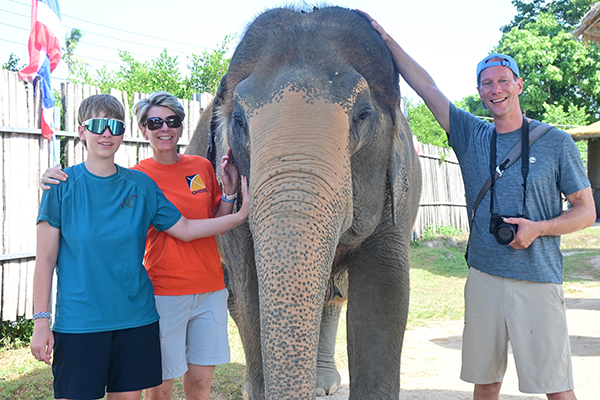 What are some of your hobbies, and what is one interesting thing that most community members might not know about you?
Outside of work, I enjoy spending time with my family and travelling, both with my own family and with my OHDSI family.
Something many people in the community may not know is that I recently became a certified football referee.
At first glance, refereeing and health data have very little in common. But I’ve discovered some surprising similarities: both require you to make decisions based on imperfect information, communicate clearly, and bring people together around a shared set of rules.
There is one important difference, though: in OHDSI, people are usually much nicer when you make the wrong call!