- Who We Are
- Updates & News
- Standards
- Software Tools
- Network Studies
- Community Forums
- Education
- New To OHDSI?
- Community Calls
- Past Events
- Workgroups
- Tutorials
- 2025 ‘Our Journey’ Annual Report
- Current Events
- Support & Sponsorship
- 2025 Global Symposium
- 2026 Europe Symposium
- 2026 Global Symposium
- Github
- YouTube
- X/Twitter
- Newsletters

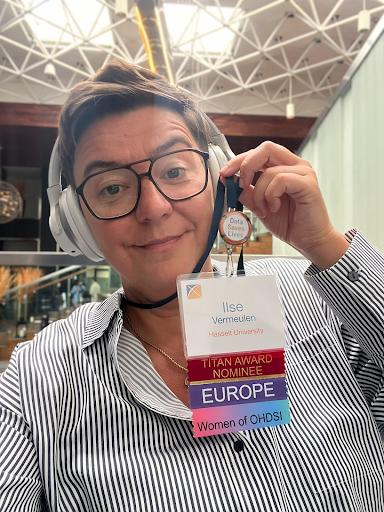
In the latest edition of the Collaborator Spotlight, Ilse discusses her career journey, her work with the Belgian National Node and the 2025 Europe Symposium, the future possibilities for European healthcare, and plenty more.
Can you discuss your background and career journey?
When I look back, the non-linear path of my career has become one of its greatest strengths. In high school, I studied economics and mathematics due to limited local options, but I realized my interests lay in science. I chose bioengineering at university, drawn to curiosity-driven learning—while I like medical content, I never had an affinity for body fluids, and attending the VUB medical campus would have been logistically difficult.
I specialized in medical cell and gene biotechnology, completing my master’s thesis on camel antibodies. Before starting a PhD, I spent time working at the campus Kultuurkaffee—an unexpectedly formative period that gave me space to reflect on the kind of research I wanted to pursue. I eventually joined the Diabetes Research Center at Vrije Universiteit Brussel, completing a PhD in Medical Sciences focused on prediction models in Type 1 Diabetes. During this time, I became a “DIY epidemiologist,” working hands-on with large datasets and linking data closely to care and real-world decision-making.
Transitioning to the job market was not straightforward. Trained as a bioengineer with a PhD in Medical Sciences, I didn’t fit neatly into traditional roles. I worked as scientific lead in a clinical laboratory, gaining insight into regulated environments, quality systems, and healthcare operations. Later, at the University of Applied Sciences UCLL, I led research on Environment & Health and Technology Enhanced Care, integrating digital tools and data to support healthcare processes.
A turning point came at a symposium on “Big Data in Health & Care,” where I encountered the work of Prof. Liesbet M. Peeters. Joining her group allowed me to combine biomedical science, applied research, and systems thinking. Looking back, each step—including the detours—shaped my current work at the intersection of health data, collaboration, and system transformation, helping build conditions that enable meaningful reuse of data to improve healthcare.
You serve as the National Node Manager for OHDSI Belgium. Why are regional and national OHDSI nodes so critical to improving healthcare decision-making in Europe—and to advancing the global OHDSI mission?
My personal motivation for engaging so deeply with the national node concept crystallized during my first encounter with the broader OHDSI community at the 2023 OHDSI Europe Symposium. I remember returning home with an incredible sense of energy and inspiration. Being surrounded by like-minded people—across countries, disciplines, and institutions—who are all working toward the same goal makes it very tangible what an open, collaborative community can achieve. And while the now somewhat famous OHDSI Belgium–branded beers may have helped break the ice, the real driver was the shared sense of purpose.
That experience also highlighted why national and regional nodes are so essential. Europe’s healthcare and research landscape is inherently fragmented, and Belgium is perhaps one of the clearest examples of this reality: the country has six governments and three official languages. Coordination across institutions, regions, and policy levels is therefore anything but straightforward. National nodes provide a critical connective layer, translating global OHDSI principles into local practice and creating trusted spaces where hospitals, researchers, and other stakeholders can work through complexity together.
In Belgium, OHDSI Belgium helps prevent institutions from tackling the same challenges in isolation. By promoting knowledge exchange, shared learning, and practical collaboration, the node reduces duplication and lowers the barrier to adopting common standards. Even without structural funding, the community continues to grow—driven by trust, mutual support, and a shared belief that collaboration is more effective than working alone.
From a European and global perspective, national nodes anchor OHDSI in real-world implementation. They ensure that federated research is not only technically aligned but also socially and institutionally sustainable. For me personally, being a National Node Manager means helping create the conditions in which people feel supported to engage—connecting local realities to a global mission and turning collective enthusiasm into lasting impact.
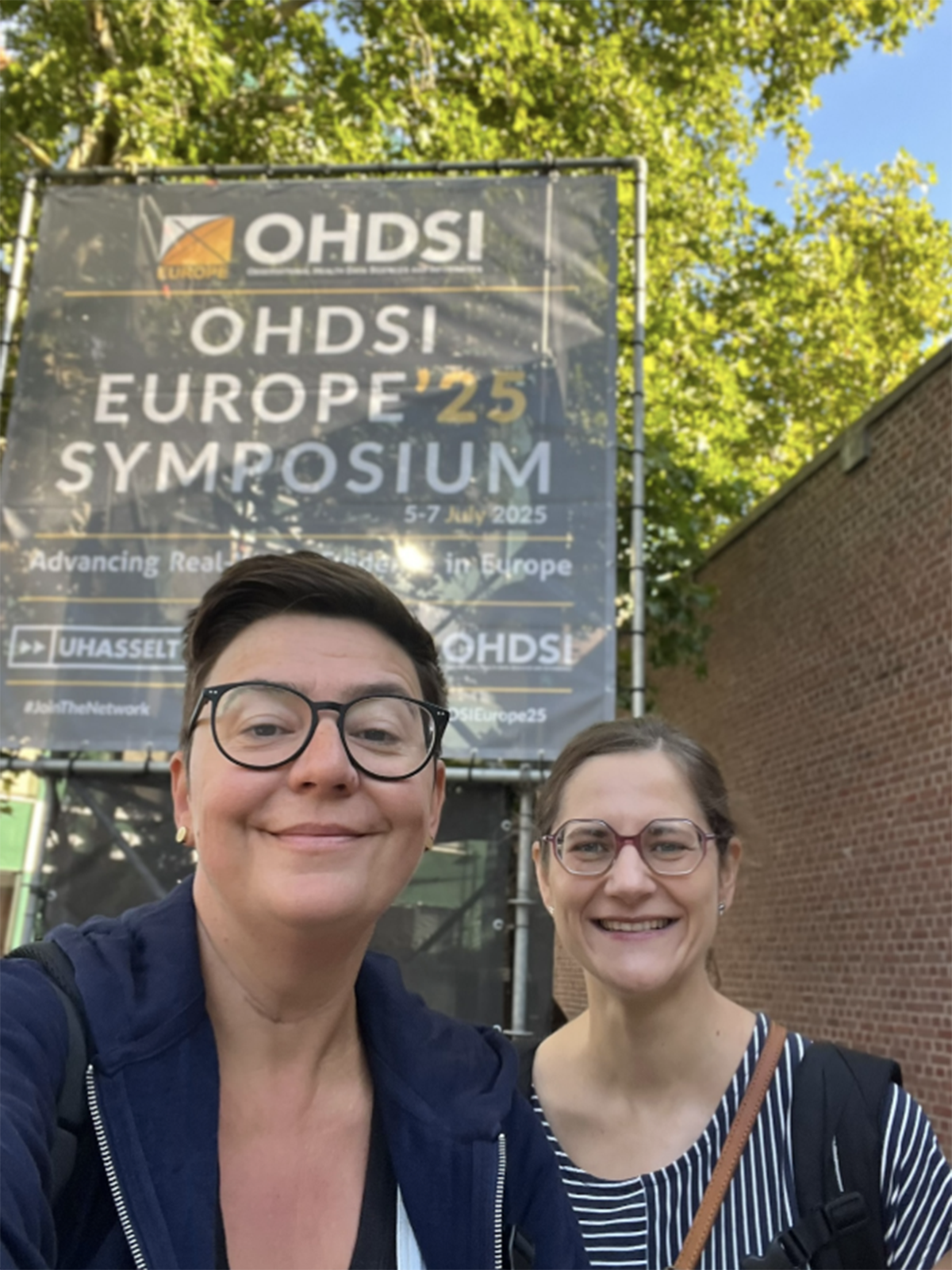 You played a central role in bringing the 2025 OHDSI Europe Symposium to UHasselt, which many considered a major success. What was it like to lead an international OHDSI event, and what did you learn about the community during those three days that surprised you?
The moment it truly became real for me was when Liesbet announced that Patrick Ryan and Peter Rijnbeek had suggested we host the Europe Symposium—making us the first organizers outside the coordinating center at Erasmus MC in Rotterdam. I felt immensely proud. That suggestion felt like a vote of confidence: a recognition that we had shown trustworthy behavior within the community and that what we were contributing was genuinely valued. It wasn’t just about hosting an event; it was about belonging and being trusted to carry something important.
Once we decided to go for it, our small team dynamic really came into play. I tend to be the person who says, “Yes, let’s do this,” without fully considering the scale of what’s required, while Lotte Geys is the one who carefully reasons things through and asks the critical questions before diving in. Fortunately, we reached consensus quickly and decided to take on the heavy lifting together with the three of us—Liesbet, Lotte, and myself—supported by the wider OHDSI community. The scientific program, in particular, was a true community effort, with support from Patrick and Peter on abstract review, practical guidance from the Erasmus team, and invaluable contributions from community leaders who led the weekend workshops.
That said, the weeks leading up to the symposium were intense—logistics always are. I learned, for example, that there are far more dietary restrictions than I ever imagined. But all of that faded once the event started. Despite a venue that was a bit too warm—thanks to a heat wave the week before and an Old Prison building without air conditioning—every single attendee brought their A-game. The energy, openness, and excitement were palpable. People genuinely wanted to be there, to contribute, and to connect. It really felt like a “framily.”
What surprised me most was just how strong and resilient the community is when given space and trust. This symposium marked the first time the Europe event traveled outside Rotterdam, and it became a milestone for introducing a rotating hosting model—alternating between Erasmus MC and national nodes across Europe. For Belgium, hosting also carried symbolic weight. We wanted to signal to policymakers that there is a large, active community working on the secondary reuse of health data, on harmonization, and on standardized analytics. In the context of the upcoming EHDS regulation and the work of the Belgian Health Data Agency, it mattered to show: we are here, we are organized, and we are recognized not only nationally, but across Europe and globally.
You were honored with the 2025 Titan Award for Community Collaboration. What did that recognition mean to you personally, and how do you define “collaboration” in the context of your work?
Receiving the Titan Award for Community Collaboration was deeply meaningful to me, precisely because collaboration is something I never set out to formally specialize in. I am not the most technical person in the room, and I never followed dedicated training to become an ecosystem or community manager. Instead, I grew into this role organically—by discovering new skills while simply doing the work and responding to what was needed at each step. I still remember a professor during my PhD once jokingly saying, “Ilse, that is not really an assistant teacher—she is way too social for that.” In hindsight, that comment probably captured my strengths better than any job description ever could.
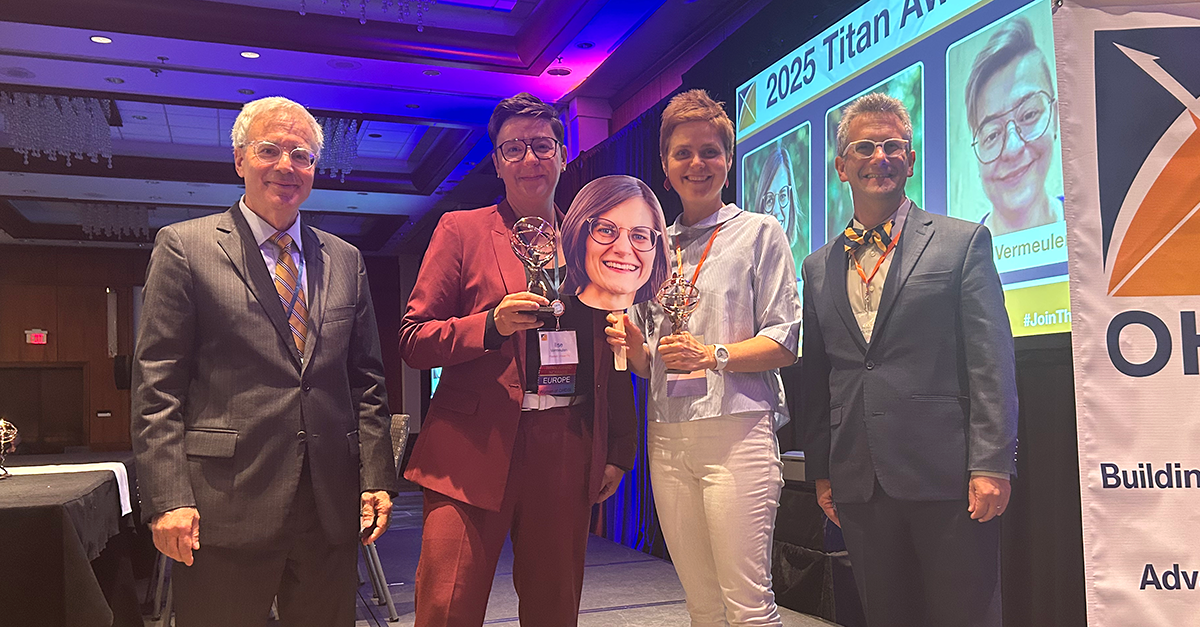 The Titan Award felt less like recognition of an individual contribution and more like recognition of a collective way of working. I still occasionally experience a touch of impostor syndrome—wondering what I am doing among such a brilliant group of people—but that feeling is also a reminder of how strong, generous, and supportive the OHDSI community is, and how collaboration here is about lifting each other up rather than competing for visibility.
When I enter a new group, I tend to stay in the background at first, observing and listening. But once I feel comfortable, I often become the glue—connecting people, translating between perspectives, and sometimes, admittedly, speaking up a bit too loudly when needed. For me, collaboration is not about hierarchy or formal roles; it is about creating trust, psychological safety, and momentum, so that people feel confident enough to contribute even if they do not yet have all the answers.
I have recently been strongly influenced by the idea of humanizing data strategies, particularly through the work of Tiankai Feng (thank you, Joeri, for the reading tip!), and his emphasis on leading data with both head and heart. While technologies, processes, and standards are essential, most challenges in data-driven initiatives are human and organizational: silos, misalignment, lack of trust, or fear of change. In the context of OHDSI, collaboration means co-creation—finding the balance between structure and flexibility, central coordination and local ownership, and ensuring that people remain at the heart of our data ecosystems.
You recently began a new role as Project Manager at Erasmus, one of the global hubs of OHDSI activity. What excites you most about joining the Erasmus team, and how do you hope to contribute to their leadership in European healthcare data and research?
Joining the Erasmus MC Medical Informatics team feels both exciting and deeply meaningful. At UHasselt, much of my work focused on community building, coordination, and so-called “civic” initiatives—important work, but often dependent on overhead funding from paid projects, which is not a sustainable model in the long run. I am very grateful that Liesbet flagged this situation within her network, and that Peter saw my potential and offered me the opportunity to join his team.
What excites me most about Erasmus MC is the chance to continue working at the heart of OHDSI Europe (and also DARWIN EU), but now within a strong and stable coordinating environment. I enjoy operating at the intersection of people, projects, and strategy—helping complex collaborations move forward by connecting perspectives, aligning efforts, and translating between policy, research, and practice.
I hope to contribute by strengthening coordination across European initiatives, supporting national nodes, and helping turn ambitious policy frameworks, such as the European Health Data Space, into something that works in practice. The Department of Medical Informatics at Erasmus MC leads not only through scientific excellence, but also through openness and collaboration, and I am very much looking forward to being part of a team that combines rigor with a strong sense of community and shared purpose.
Looking ahead, what do you see as the biggest opportunity for OHDSI in Europe over the next few years—and how can the community help realize it?
The biggest opportunity for OHDSI in Europe over the coming years lies in its ability to act as a practical bridge between policy ambition and real-world implementation. With the European Health Data Space (EHDS) becoming a reality, Europe now has a unique chance to move beyond fragmented, project-based data use toward sustainable, interoperable health data ecosystems—and OHDSI already offers many of the tools, principles, and community structures needed to make that happen.
What makes OHDSI particularly powerful in the European context is its federated, community-driven model. Europe is inherently diverse—in healthcare systems, languages, governance structures, and digital maturity—and OHDSI does not try to erase that diversity. Instead, it provides a common framework that allows local contexts to remain local, while still enabling cross-border learning, evidence generation, and collaboration at scale.
To realize this opportunity, the community’s role will be crucial. National and regional nodes can serve as trusted intermediaries between hospitals, researchers, policymakers, and European initiatives—translating standards into practice, sharing lessons learned, and building capacity where it is most needed. At the same time, continued openness, mentorship, and collaboration within the OHDSI community will be essential to lower the barrier to entry and ensure that new participants feel supported rather than overwhelmed.
Ultimately, I believe that if OHDSI can continue to combine technical excellence with a strong focus on people, governance, and trust, it has the potential to become a cornerstone of how Europe generates real-world evidence—turning regulatory momentum into meaningful, patient-centered impact.
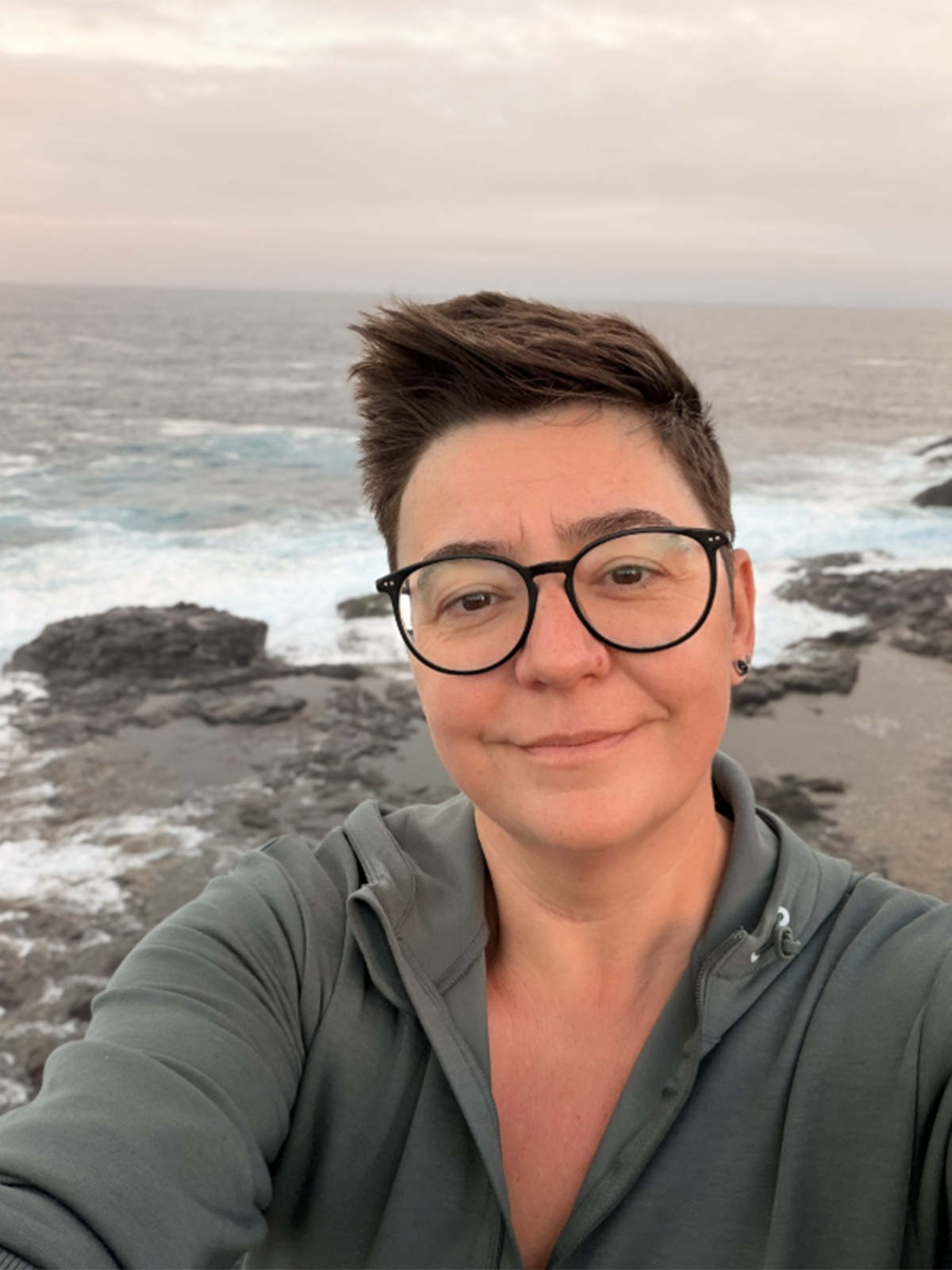 What are some of your hobbies, and what is one interesting thing that most community members might not know about you?
Outside of work, I recharge through movement, nature, and good company. I enjoy hiking and long nature walks, cycling—mostly on my race bike, and I recently joined the UHasselt Cycling Team—and swimming whenever I get the chance. I also love nature photography and traveling, especially when it allows me to slow down and observe different cultures and landscapes.
Cooking is another important outlet for me. I genuinely enjoy preparing meals for friends and family, bringing people together around food, and, of course, enjoying good food and drinks myself—including the occasional fine-dining experience. I am very much a people pleaser when it comes to those I care about, and I have a soft spot for helping people who are struggling. That extends into my professional life as well—for example, I recently secured funding for a project on epilepsy in the Democratic Republic of Congo, with the hope that it may one day connect to OHDSI Africa once sufficient data infrastructure is in place.
Something that many people in the community might not know about me is that I used to be a competitive swimmer. I trained for nearly 20 hours a week, was part of the Belgian National Team for several years, won national titles, and reached the semi-finals at the European Championships. Swimming taught me discipline, resilience, and the value of teamwork—lessons that still shape how I approach collaboration today, even far outside the pool.
