
Sept. 29, 2026
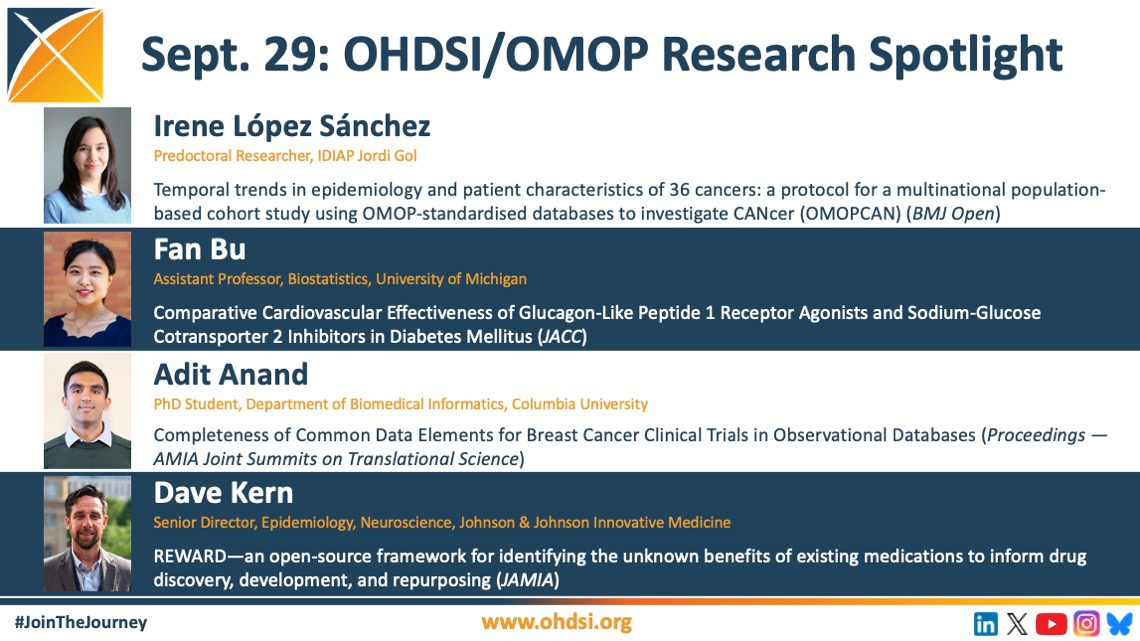 The OHDSI community has published more than 1,100 studies over more than a decade, and lead authors from four different recent publications joined the Sept. 29 community call to briefly present their study.
- Irene López Sánchez (Predoctoral Researcher, IDIAP Jordi Gol)
- Fan Bu (Assistant Professor, Biostatistics, University of Michigan)
- Adit Anand (PhD Student, Department of Biomedical Informatics, Columbia University)
Completeness of Common Data Elements for Breast Cancer Clinical Trials in Observational Databases (Proceedings — AMIA Joint Summits on Translational Science)
- Dave Kern (Senior Director, Epidemiology, Neuroscience, Johnson & Johnson Innovative Medicine)
Community Updates
• Congratulations to the team of Marco Caminati, Jeremy Charriot, Aruna T Bansal, Shane Hanon, Renaud Louis, Florence Schleich, Muriel Delvaux, Guy Brusselle, Stéphanie Ziant, Virginie Paulus, Sanja Grle Popovic, Gordana Pavlisa, Marina Lampalo, Celeste Porsbjerg, Kjell Håkansson, Susanne Hansen, Arnaud Bourdin, Eve Klising, Candice Estellat, Caroline Giboin, Dounya Metdaoui, Zsuzsanna Csoma, Dora Lúðvíksdóttir, Giorgio Walter Canonica, Enrico Heffler, Cristina Cardini, Anna Alloni, Iveta Kroica, Kristina Bieksiene, Romain Tching, Anneke ten Brinke, Jacob Sont, Piotr Kuna, Maria Morawska, Florin Mihaltan, Sanja Hromis, Aleksa Golubovic, Mihailo Stjepanovic, Vojislav Ćupurdija, Peter Kopac, Valentyna Yasinska, Fabienne Jaun, Joerg Leuppi, Ebru Damadoglu, Ozlem Goksel, Sabina Skrgat, Ratko Djukanovic, and Bilun Gemicioglu on the recent publication of Biologic outcomes in severe asthma patients by smoking status: evidence from SHARP in the American Journal of Respiratory and Critical Care Medicine.
• Congratulations to the team of Jaleh Shoshtarian Malak, Leonie von Berlin, Irina Balaur, Rada Hussein, Philip Gribbon, Yojana Gadiya, Somayeh Abedian, Andreas Kremer, Stefan Sauermann, Francisco J Núñez-Benjumea, Jens Declerck, Sumit Madan, Hanna Ćwiek-Kupczyńska, Lukas Rohatsch, Holger Fröhlich, Christian Muehlendyck, and Venkata P Satagopam on the recent publication of Bridging Gaps in Standards for the Secondary Use of Health Data: Exploratory Standard, Tool Assessment, and Feasibility Study in JMIR Formative Research.
• Congratulations to the team of Jennifer N Hoppe, Jocelyn Lee, Tomi F Akinyemiju, Danielle S Bitterman, Michael Brudno, Michelle F Green, Vojtech Huser, Jafi A Lipson, Sanjay Mishra, Daniel P Nussbaum, Jai N Patel, Valentina I Petkov, Kelli M Rasmussen, Sahussapont Joseph Sirintrapun, Patricia A Spears, Sebastiaan Van Sandijk, Anne-Marie Meyer, Umit Topaloglu, and Jeremy L Warner on the recent publication of The GENIE Data Model: A Solid Tumor, Person-Centric Framework for Scalable, Harmonized Precision Oncology Data Collection in Cancer Research Communications.
• Congratulations to the team of Melissa Y Wei, Ashley J Kang, Alexandra M Klomhaus, Lucia Y Chen, Douglas S Bell, David Elashoff, and Chi-Hong Tseng on the recent publication of Computable phenotypes for multimorbidity measurement: development and implementation of a new electronic health record-based multimorbidity-weighted index for harmonized Observational Medical Outcomes Partnership data in JAMIA.
• Congratulations to the team of Jungha Min, Sueun Shin, Sohyeon Park, Jeongha Yun, Kaylnn Park, and Sandy Jeong Rhie on the recent publication of Real-World Antidepressant Prescribing Patterns and Comparative Safety Outcomes of Commonly Prescribed Antidepressants in Patients with Depressive Disorder: A Multicenter OMOP-CDM Study in Pharmaceuticals.
• Congratulations to the team of Seunggyeong Lee, Yeonju Woo, and Soojin Lee on the recent publication of Representing Traditional East Asian Medicine in International Health Informatics Standards: A Scoping Review in Healthcare.
• Congratulations to our 2026 Titan Award nominees: ASSURE team, David Bard, Robert Barrett, Clair Blacketer, Rich Boyce, Danielle Boyce, Evanette Burrows, Cindy Cai, Carrot and Bunny Team, Cindy Chen, Pascal Coorevits, Data4Life, Scott Duvall, Noemie Elhadad, Lee Evans, Eye Care and Vision Research WG, FastOMOP, Mornin Feng, Davera Gabriel, Josh Gagne, Sarah Gasman, Lars Halvorsen, Peter Hoffmann, Christian Högberg, Michelle Hribar, Jason Hsu, Ben Illigens, Andy Kanter, Elisse Katzman, Masha Khitrun, Mack Kigada, Chungsoo Kim, Chris Knoll, Haeun (Hannah) Lee, Gaeun Lee, Renske Los, Benjamin Martin, Valentina Martufi, Mind Meets Machine, Evan Minty, Karthik Natarajan, Bill O’Brien, Sean O’Reilly, OHDSI UK organizers, Julio Oliveria, Anna Ostropolets, Woo Yeon (Jen) Park, Rowan Parry, Paul Petraro, Melanie Philofsky, Hanieh Razzaghi, Jenna Reps, Harry Reyes Nieva, Marti Sabate, Craig Sachson, Alexander Saelmans, Martijn Schuemie, Sarah Seager, Anthony Sena, Cynthia Sung, Jim Todd, Mui Van Zandt, Annelies Verbiest, Fleur Vereijken, Katia Verhamme, Ilse Vermeulen, David Vizcaya, Tom White, Qi Yang, Seng Chan You, Bingyu Zhang
• Jiwon Um, a PhD student at Yonsei University in Korea, introduced a brief survey focusing on OHDSI in the Era of Medical AI. Medical AI is reshaping how observational research evidence is generated and used. The OHDSI community has spent more than a decade building infrastructure — OMOP CDM, standardized vocabularies, federated networks, open-source methodology — that may have a distinctive role in this transition. This survey asks how you, as a member of the community, see that role and the tensions surrounding it.
• Registration is open for the 2026 OHDSI Canada Symposium, held Nov. 17-18 in Toronto. This two-day event will bring together researchers, clinicians and data scientists, trainees along with public sector and industry partners from across Canada and beyond to explore the growing use of the OMOP Common Data Model and OHDSI in observational health research. The event will feature a workshop day on Nov. 17 and a main conference day on Nov. 18.
• Registration is open for the 4-day OMOP School in Uppsala, Sweden on Oct. 13-16. There are fewer than 10 spaces remaining, so don’t wait until the final moment to register.
• A call for papers is open for a Journal of Biomedical Informatics special issue focusing on agentic AI for generating trustworthy Real-World Evidence (RWE). The issue seeks contributions on multi-agent collaboration and coordinated autonomy across the RWE lifecycle—such as data harmonization and causal analysis—while excluding single-task AI agents. Submissions are accepted from June 15 through November 15, 2026, with publication slated for September 2027.
• The FALCON (Federated Alliance for Large-scale Cancer Observational Network) Research Network is dedicated to advancing real-world oncology evidence through federated health analyses. The network is hosting its 2026 Symposium and Bladder Cancer Studyathon from Sep. 28-Oct. 1 at Dunden in Antwerp, Belgium. This intensive four-day event kicks off with a general symposium followed by a three-day collaborative working session for researchers, clinicians, and data scientists to generate high-quality clinical evidence on the OMOP CDM.
Job Openings
• Michelle Hribar shared openings for two new positions in her lab at the University of Illinois at Chicago:
-
Director of Informatics and Data Science Operations and Development at UIC’s CTSA. This position involves directing the team at the biomedical informatics and data science core. Dr. Michelle Hribar is the Associate Director of the core, so she will be working closely with this person, which will developing our OMOP instance and expanding our involvement in the OHDSI Evidence Network.
-
Post-doc in Dr. Michelle Hribar’s lab at UIC. This position will involve implementing the imaging reference standard at UIC and working on federated learning for multimodal models that use the OMOP CDM. It will initially focus on ophthalmic imaging and models but hopefully will extend to other imaging as well.
Upcoming Events
• Registration is open for the 2026 OHDSI Global Symposium, held Oct. 20–22 at the Hyatt Regency in New Brunswick, N.J. You can also read more about our 12 new tutorial offerings and workgroup activities which will take place during the event.
• Registration is open for the 2026 OHDSI APAC Symposium, which will take place Nov. 13-15 at Yonsei University in Seoul, South Korea. This will be a 3-day event, kicking off with the main conference and then including tutorials and a datathon during the weekend. Please check the event homepage for details on the agenda.
• Registration is open for the OHDSI Canada Symposium, held Nov. 17-18 in Toronto, Ont. The event will feature a workshop day on Nov. 17 and a main conference day on Nov. 18.
• The third annual OHDSI India Symposium has been scheduled for December 11th in Chennai. More details and registration information will be shared with the community as they become available.
Social Showcase
• Research from the 2026 Europe Symposium Collaborator Showcase is being shared daily on OHDSI’s LinkedIn, Twitter/X, Instagram and Bluesky social channels as part of the #OHDSISocialShowcase. Below are posters (with study leads) that are featured this week:
Monday — PandemicPrediction: three-year temporal validation of Seek-COVER models during the COVID-19 pandemic (Egill Fridgeirsson)
Tuesday — Comparing Human and AI-Derived DRG Severity of Illness Using OMOP CDM: A Belgian APR-DRG Case Study (Peter Heirman)
Wednesday — A SNOMED CT Template–Based Interoperability Framework for Multi-Standard Outputs (Thibault Helleputte)
Thursday — MedValence: A Distributed Methodological Framework for Developing and Validating Personalized Prediction Models of Drug Efficacy and Safety Using Real-World Data (Nguyen Phung-Anh)
Friday — Scaling laws for autoregressive foundation models on observational health event streams (Egill Fridgeirsson)
Slides
López Sánchez | Bu | Anand | Kern | Community Updates
Video Presentation
Temporal trends in epidemiology and patient characteristics of 36 cancers: a protocol for a multinational population-based cohort study using OMOP-standardised databases to investigate CANcer (OMOPCAN) (López Sánchez)
Comparative Cardiovascular Effectiveness of Glucagon-Like Peptide 1 Receptor Agonists and Sodium-Glucose Cotransporter 2 Inhibitors in Diabetes Mellitus (Bu)
Completeness of Common Data Elements for Breast Cancer Clinical Trials in Observational Databases (Anand)
REWARD—an open-source framework for identifying the unknown benefits of existing medications to inform drug discovery, development, and repurposing (Kern)