
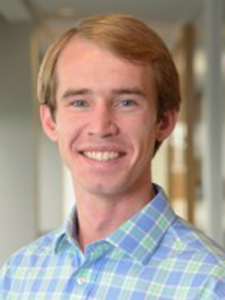
Can you discuss your background and how you first became involved with the OHDSI community?
I started in health informatics working at a regional Health system in South Carolina and in the business intelligence department doing internal reporting working with EHR data, balancing charges from the EHR with the General Ledger, and learning how messy and challenging real world data was. I went back to Graduate School to study health informatics at Clemson University and the Medical University of South Carolina where I worked with Dr. Brent Egan at the American Medical Association studying hypertension treatment using real world data. I was attending the American Medical Informatics Association Symposium in 2022 around the time I was tying up my thesis when I saw George and Anna and the LEGEND Hypertension study team present their results, and this was my first introduction to OHDSI. I had a existential crisis (the good kind) attending that presentation and realized I need to I find a way to become involved with this community that is able to do generate real-world evidence at the level of these “LEGEND” studies. Later that same day I met Paul Nagy at the Johns Hopkins booth and found an opportunity to work as a postdoc at Johns Hopkins and their biomedical informatics and data science department. Now I am faculty here with Johns Hopkins BIDS and have been working with our clinicians here as study leaders and data partners in OHDSI network studies for about 3 years now. We teach informatics and observational research methods through the lens of the OHDSI data to evidence pipeline to graduate students in informatics, biomedical engineering, biostatistics, and to our medical students, residents, fellows, and faculty physicians.
You have helped bring OHDSI and the OMOP CDM into the curriculum at Johns Hopkins. What is the biggest “aha!” moment students typically have when they first start working with these global standards?
I would say the first and one of the biggest aha moments is when the cleverness of sharing code not data, enabled by decentralized harmonization to the common data model clicks for students. It often happens when they think about how to communicate their proposed network study to the Institutional Review Board. There’s a particular field that specifies if this a multi-center or single site project and understanding that from the IRB’s perspective this is actually a single site study is what solidifies the federated analysis model in their minds. Then the whole mess with standardized vocabularies, the common data model, and the network analysis packages seem to make a lot more sense in that moment.
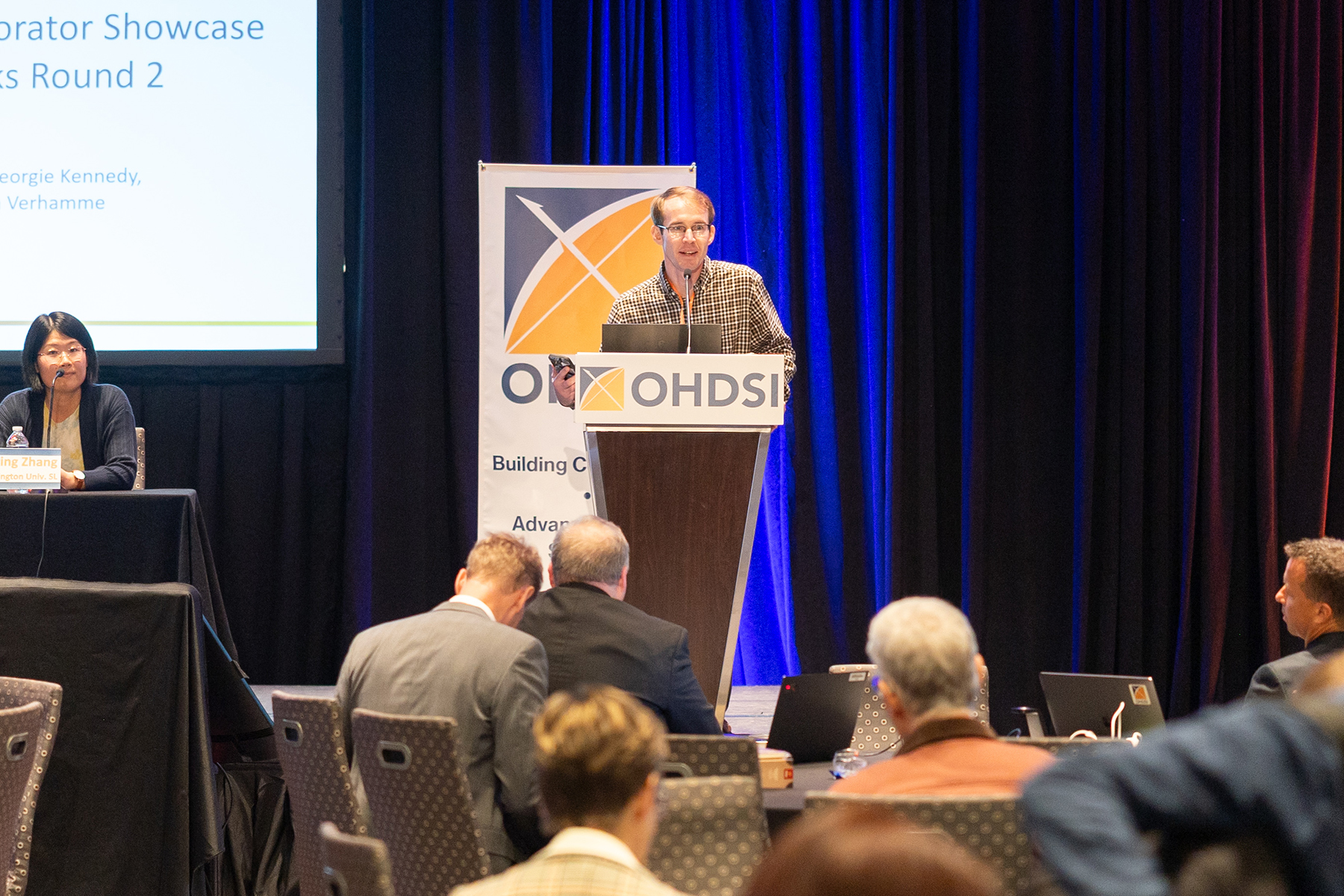 As a co-lead in the Early-Stage Researcher (ESR) workgroup, what do you see as the most significant barrier for new researchers entering the community, and how is the group helping to lower that hurdle?
It seems like a significant barrier for new researchers coming to OHDSI is the unorthodox nature of working in an open science community as opposed to a classical, closed research lab. There are definitely a lot of people looking for the official front door, or the person who can anoint them as an official member of the OHDSI community, so the lack of walls, much less doors, seems to throw people off. It usually manifests as confusion about where to get started and how to move forward. In the early stages, people often look for validation that they’re doing things the right way.
We’re in a good position in the ESR Working Group to provide the information, guidance, and direction for where people can go to see what’s been done before and how, while also acknowledging that feeling of questioning your every step and doubting yourself as a valid and qualified OHDSI contributor. We’re staunchly anti-imposter-syndrome in the ESR Working Group.
OHDSI is known for its “open door” policy, where junior researchers can make an immediate impact, but also find mentorship. How does the dynamic between OHDSI veterans and newcomers help ensure both stability and growth?
This is critical, and it’s why one of our primary OKRs in the ESR Working Group is to provide a structured forum for connecting veteran OHDSI luminaries with more junior OHDSI collaborators and contributors. Every month, we spend about 20 minutes of the ESR meeting giving the floor to a chosen and willing OHDSI veteran to tell the story of their career path to and through the OHDSI community, as well as making time for direct dialogue and questions from the community of junior researchers who come to the working group call.
As far as stability and growth, everything in OHDSI can be attributed to the community—whether it’s maintaining software, running network studies, applying statistical methods, or bringing in clinical expertise. Learning how best to continue this work in these foundational areas of OHDSI is done best with the support and supervision of someone who has simply done it more and for longer, and who has a larger collection of growth experiences to share with others, who then become that same person for someone else. Learning by example and modeling successful behaviors is something that is an important tool to our species, and to our open science community.
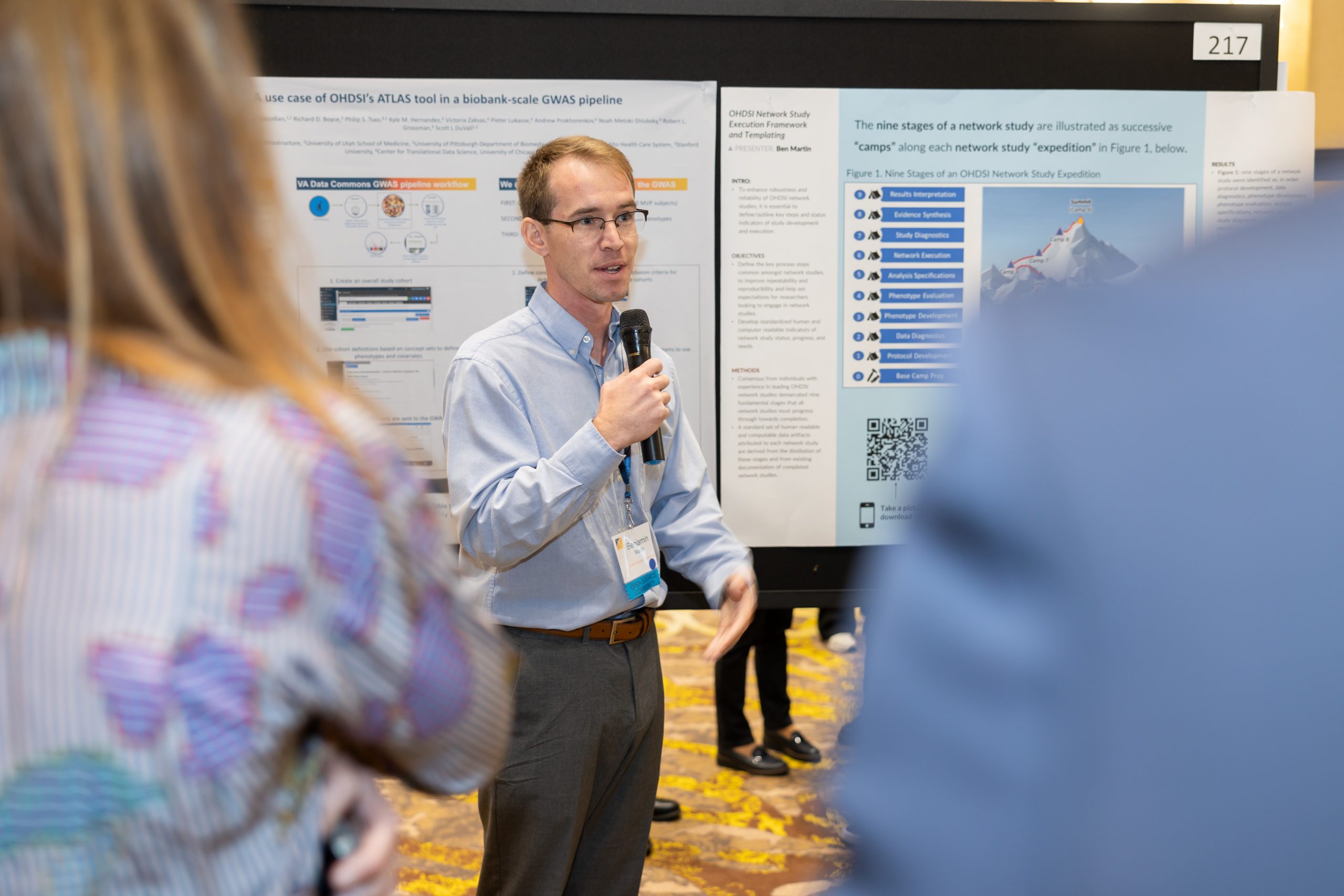 Beyond education and community building, can you tell us about your current research and how the OHDSI toolset enables you to research questions that wouldn’t be possible with a single-site dataset?
At the moment, I find myself somewhat clinically agnostic with my informatics research, applying the OHDSI toolset and federated network analysis approach to many different clinical problems and questions. What continues to be the most glaring opportunity to move the ball forward across clinical domains is the chance to perform observational analysis on rare diseases or specific clinical/demographic subgroups that are underrepresented or simply cannot be studied in single-site datasets. It feels very good to bring this opportunity to researchers working to reverse the bias inherent in our clinical evidence base because of the inability to ask all-by-all type questions or from underrepresentation of rare clinical phenomena and demographic minorities.
Looking ahead to 2026, what is one major goal you have for the ESR workgroup or for OHDSI’s footprint in academic education?
One of our major goals in the ESR Working Group is to expand the global footprint of our ESR community. Through that effort, we anticipate fruitful cross-pollination of successes and opportunities in bringing informatics and observational research methodologies to academic education. We all have a lot to learn from each other, and I’m excited to have those conversations about how we teach informatics and observational data science with other scientists across continents.
What are some of your hobbies, and what is one interesting thing that most community members might not know about you?
An interesting thing that community members might not know about me is that I’m a huge nature-lover and always have been. I used to study wildlife and ecology for fun when I was very little. I had a whole CD set from the Audubon Society of birds call recordings so I could identify birds by their call. My love for nature has manifested these days through gardening. I have a small container garden on the roof of our rowhouse in Baltimore city with flowers, tomatoes, peppers, herbs and other vegetables, and it is my biggest obsession outside of work. Outside of that: running, hiking, fishing and anything that gets me outside and into nature are hobbies of mine.