
2025 OHDSI APAC Symposium

December 6-7 • Shanghai Jiao Tong University, China
Minhang Campus, China

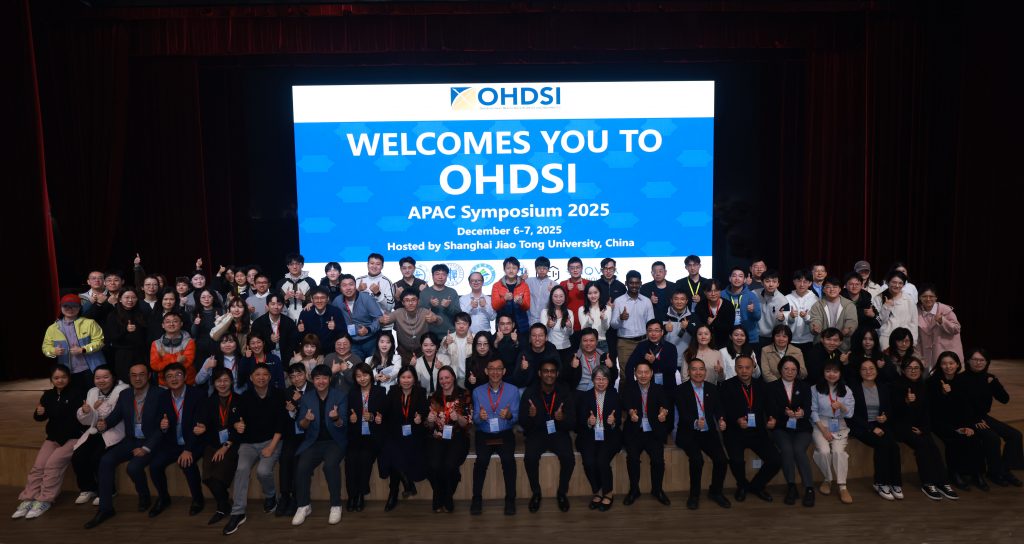
The 2025 OHDSI APAC Symposium welcomed a fully-engaged group of over 150 registrants during its annual event, held Dec. 6-7 in Shanghai, China. The symposium offered valuable insight into the current landscape of healthcare data and research in China, and it created an important platform to further expand awareness and adoption of OHDSI across the APAC region.  

The program featured an introductory OMOP CDM tutorial with strong hands-on participation, alongside updates on the progress of the 2025 APAC Studies launched in March. Through the showcase of OMOP CDM transformation efforts and LLM-based, multimodal AI approaches for generating real-world evidence, the symposium emerging innovations in data standardization and analytics.  

Overall, the event strengthened global collaboration and in-person connections, while building momentum to advance APAC-led studies into 2026. 

2025 OHDSI APAC Symposium Agenda 

Day 1 – Tutorial

Morning Session

Afternoon Session

Day 2 – Conference

Session 1 – From Global to Regional Impact: OHDSI across APAC & Africa

  • Opening Speech (University Vice President)
  • Keynote Speech: From Data to Impact: OHDSI’s Role in RWE (Mui Van Zandt)
  • APAC Regional Chapter Updates (Korea, India, Japan, Singapore, Malaysia, Vietnam, Australia)

Session 2 – From Research to Reflection: 2025 APAC Studies and Lessons Learned

  • Database: from FPG to Medical Burden (Jiaqi Liu, Fudan)
  • GLP-1 vs SGLT-2 in T2D (Observational Study) (Sun Feng, Peking)
  • Disease Trajectory of T2D with Transformer Models (Shilu (Margaret) Liu, USTC)
  • Standards of Observational Research (Seng Chan You, JACC)
  • 12:10 – 12:30 Panel Discussion

Session 3 – From Regional Insights to Local Challenges: Real-World Evidence and OHDSI/OMOP in China

  • Collaborator Showcase: Lightning Talks
  • The Huatuo LLM & AI for EBM (Guangjun Yu)
  • AI-driven Biomedical Multimodal Data Analysis (Huiying Liang)
  • RWE: From Observational to Analytical Studies (Le Gao)
  • Large Model powered OMOP CDM Mapping (Mengchun Gong)
  • AI-assisted Prescription Review System (Bo Jin)
  • Transforming Prostate Cancer Outcomes Data to OMOP (German Zhu, Bayer & Meng Yin)

Posters

  1. THESEUS: An LLM-powered Software Bridging the OHDSI Ecosystem OMOP-CDM Observational Studies, Hanjae Kim, Yonsei University 
  2. Structuring Asia-Pacific Digital Therapeutics Regulatory Data within the OMOP Common Data Model, Jiayue Guo, School of Health Policy and Management, Peking Union Medical College 
  3. Safety and Effectiveness Comparison of Metal versus Plastic Biliary Stents Using CDM: A Pilot Study for Post-Market Medical Device Surveillance System, Yiju Park, Yonsei University 
  4. ODharmonizer: Enabling Omics Data Harmonization in OMOP CDM, ErwinTantoso, A*Star Bioinformatics Institute 
  5. Effectiveness and safety ofsitagliptin added to metformin in real -world type 2 diabetes patients: a target trial emulation study, Xiaowei Chen, Peking University 
  6. Data2Evidence AI-Powered Chat Assistant for OHDSI Analytics Pipeline, MinZhi, D4L data4life Asia Limited 
  7. Leveraging Generative Large Language Model to Populate OMOP Oncology CDM from the EHR: Feasibility Study, Subin Kim, Yonsei University 
  8. Mapping Standardized Nursing Statements to OMOP Common Data Model, Hyeoneui Kim, Seoul National University 
  9. Integrated OHDSI Network Study Design and Execution in Data2Evidence, Satan Maddi, D4L data4life Asia Limited 
  10. Use of GLP-1 Receptor Agonists and Risk of Acute Liver Injury: A Cohort Analysis in the OMOP CDM (GLP1-ALI), Evelyn Goh, National University of Singapore
  11. CharacterisingCancer Patients in Taiwan Using Real-World Data: Contributions to the OHDSI Network study, Thi Kim Hien Nguyen, Taipei Medical University 
  12. Burden Of Heart Failure in Patients with Chronic Kidney Disease: Evidence from Taipei Medical University, Than-Phuc Phan, University Medical Center HoChi Minh City 
  13. Treatment with antidiabetics in patients with T2D and CKD – Evidence from Taipei Medical University OMOP CDM, Than-Phuc Phan, University Medical Center HoChi Minh City 
  14. Predicting Dementia Risk in Chronic Kidney Disease Patients: A Patient-Level Prediction Model Using the Taipei Medical University Database,Thi Hong Hanh Nguyen, Taipei Medical University 
  15. The Practice of Multinational Standardized Data Collaboration: Preliminary Exploration of the GDE Data Report and Comparison of Internal and External Clinical Guidelines in Taiwan, Truong Nguyen, Taipei Medical School

 Lightning Talks 

  1. THESEUS: An LLM-powered Software Bridging the OHDSI Ecosystem OMOP-CDM Observational Studies by Hanjae Kim 
  2. Safety and Effectiveness Comparison of Metal versus Plastic Biliary Stents Using CDM: A Pilot Study for Post-Market Medical Device Surveillance System by Yiju Park 
  3. Effectiveness and Safety of Sitagliptin Added to Metformin in Real-World Type 2 Diabetes Patients: a Target Trial Emulation study by Xiaowei Chen 
  4. Mapping Standardized Nursing Statements to OMOP Common Data Model by Hyeoneui Kim  
  5. Data2Evidence AI-Powered Chat Assistant for OHDSI Analytics Pipeline by Min Zhi 
  6. Use of GLP-1 Receptor Agonists and Risk of Acute Liver Injury: A Cohort Analysis in the OMOP CDM (GLP1-ALI) by Evelyn Goh 


Top